

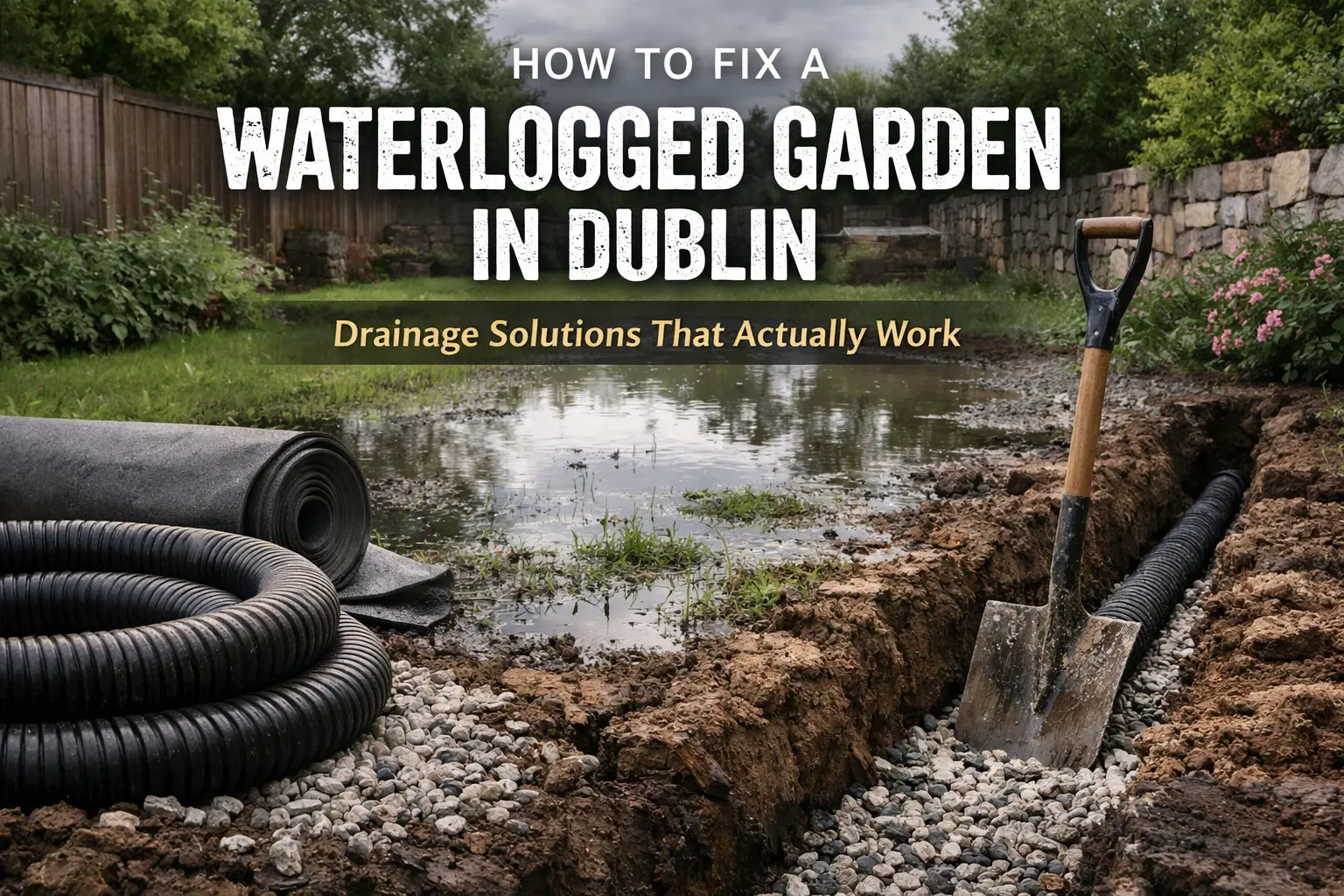
If your Dublin garden turns into a swamp after every rainfall, you’re not alone. Waterlogging is one of the most common garden problems in Ireland, made worse by heavy clay soils, poor original drainage, and increasingly intense rainfall patterns. A waterlogged garden isn’t just an eyesore — it kills grass and plants, creates a breeding ground for moss, compacts soil, and can even threaten the foundations of your home if water consistently pools against walls.
The good news is that every waterlogged garden has a solution. At Lion Paving & Landscaping, we install drainage systems as part of our landscaping projects across Dublin and Kildare. This guide explains the causes, signs, and most effective solutions available.
How to Tell If Your Garden Is Waterlogged
Waterlogging isn’t always obvious. Sometimes the surface looks fine, but the soil beneath is saturated. Watch for these signs: standing water that takes more than 24 hours to drain after rain; a lawn that feels spongy or squelches underfoot; excessive moss growth across the lawn; patches of yellowing or dying grass; a sour or stagnant smell from the soil; plants showing root rot (wilting despite wet soil); and worm casts disappearing (worms leave compacted, waterlogged soil).
Why Dublin Gardens Flood: The Common Causes
Heavy Clay Soil
Much of Dublin sits on heavy clay subsoil, particularly in areas like Lucan, Clondalkin, Blanchardstown, and parts of South Dublin. Clay soil has tiny particles that pack together tightly, leaving almost no space for water to drain through. When it rains, water sits on top of the clay rather than percolating downward. This is the single most common cause of waterlogged gardens in Dublin.
Poor Original Drainage
Many Dublin housing estates — particularly those built during the Celtic Tiger era — had gardens finished with minimal topsoil over compacted clay subsoil, with no drainage installed. The builders’ priority was the house, not the garden. The result is a thin layer of grass sitting on effectively waterproof ground.
Compacted Soil
Heavy foot traffic, children playing, construction work, and even parking vehicles on lawns compact the soil over time, squeezing out the air pockets that normally allow water to drain. Once compacted, soil behaves like clay regardless of its original composition.
Neighbouring Hard Surfaces
If your neighbours (or you) have paved over front gardens, extended patios, or built new driveways, all that rainwater that previously soaked into the ground is now running off hard surfaces and into the lowest point — which might be your garden.
Drainage Solutions That Work in Dublin
1. French Drains
A French drain is a trench (typically 300–450mm deep) filled with gravel and containing a perforated pipe. Water from the surrounding soil enters the pipe through the perforations and flows along the pipe’s gradient to a discharge point — either a soakaway, a storm drain, or a lower area of the garden. French drains are the most versatile and widely used solution for waterlogged Dublin gardens.
Best for: Lawns with persistent standing water, gardens with clay subsoil, and directing water away from the house.
Typical cost: €40–€80 per linear metre installed.
2. Herringbone Drain System
For severely waterlogged lawns, a herringbone drain system uses a main drainage pipe with smaller branch pipes extending outward in a fishbone pattern. This covers a much larger area than a single French drain and is the most effective solution for large lawns on heavy clay. The entire system feeds into a soakaway or stormwater connection.
Best for: Large lawns on clay soil, gardens with severe waterlogging across the entire area.
Typical cost: €1,500–€3,500 depending on garden size.
3. Soakaways
A soakaway is an underground pit filled with gravel, rubble, or plastic crate modules, designed to collect water and allow it to slowly percolate into the surrounding soil. Soakaways work as the discharge point for French drains and channel drains, or as standalone solutions in gardens where the soil below the clay layer is more permeable.
Best for: Gardens with no access to a stormwater drain, as a discharge point for other drainage systems.
Typical cost: €500–€1,500 per soakaway.
4. Channel Drains (Linear Drains)
Channel drains are narrow, covered trenches installed at the surface level, typically at the edge of patios, driveways, or along the boundary between a paved area and the garden. They intercept surface water before it reaches the lawn and redirect it to a soakaway or drain. Essential when installing any new patio or driveway to prevent run-off from flooding the garden.
Best for: Run-off from patios, driveways, and hard surfaces. Often installed as part of patio projects.
Typical cost: €30–€60 per linear metre.
5. Lawn Aeration and Top-Dressing
For mild waterlogging caused by compaction rather than clay subsoil, hollow-tine aeration combined with a sand top-dressing can significantly improve drainage. A hollow-tine aerator removes plugs of soil, creating channels for water to penetrate deeper. Brushing horticultural sand into the holes improves the soil structure over time. This is a cost-effective first step before committing to a full drainage installation.
Best for: Mildly waterlogged lawns, compacted soil from foot traffic, as a maintenance practice.
Typical cost: €100–€300 for professional aeration and top-dressing of an average Dublin lawn.
Quick Fixes While You Wait for Professional Help
If your garden is currently waterlogged and you can’t get a drainage system installed immediately, there are several things you can do to minimise the damage. First, stay off the lawn as much as possible — walking on waterlogged soil compresses it further, making the problem worse. If you need to cross the lawn, use wooden boards to distribute your weight.
Once the water level drops, pierce the surface with a garden fork to a depth of 10–15cm across the affected areas. This creates channels for water to drain deeper rather than sitting on the surface. Follow up by brushing horticultural sand into the holes. Clearing gutters and downpipes is also essential — blocked gutters overflow onto the ground directly beside the house, which is one of the most damaging forms of waterlogging. Make sure all downpipes are connected to a functioning drain, not just discharging onto the garden surface.
How Smart Landscaping Prevents Waterlogging
If you’re planning a garden renovation, addressing drainage at the design stage is far cheaper and more effective than retrofitting later. At Lion Paving & Landscaping, we build drainage into every project where it’s needed. This includes: installing channel drains at the edge of every new patio to intercept run-off before it reaches the lawn; laying all hard surfaces with a minimum fall of 1:60 away from the house; incorporating permeable surfaces where possible (gravel areas, permeable block paving, open-jointed slabs); creating raised planting beds with free-draining soil mixtures; and positioning soakaways beneath lawns or planting areas to handle excess rainwater.
Addressing drainage during a landscaping project typically adds 10–15% to the overall cost, but it protects the entire investment. A beautiful new patio surrounded by a waterlogged, mossy lawn isn’t the result anyone wants.
Struggling with a Waterlogged Garden?
We assess your garden’s drainage, identify the cause, and install the right solution — from simple French drains to full herringbone systems. Most drainage projects are completed in 1–2 days with minimal disruption.
Call us today: +353 85 778 0394
Or request a free quote on our contact page.
DIY vs Professional Drainage Installation
Lawn aeration and simple surface improvements can be done DIY. However, installing French drains, herringbone systems, or soakaways requires excavation equipment, knowledge of gradients and fall calculations, and an understanding of where water can legally be discharged. In Dublin, connecting drainage to the public sewer system without permission is illegal — rainwater must be managed separately from foul water in most areas. A professional landscaper will ensure the system is correctly designed, legally compliant, and actually solves the problem.
What Lion Paving’s Drainage Service Includes
When we address waterlogging as part of a landscaping project, our process includes: a full site assessment to identify the cause and severity of waterlogging; a recommended drainage solution tailored to your garden’s conditions; professional excavation using mini-diggers where needed; installation of drainage pipes, gravel backfill, and geotextile fabric; connection to a soakaway, stormwater drain, or other approved discharge point; reinstatement of the lawn, patio, or landscaping above the drainage system; and full waste removal and site clean-up.
Drainage is often installed as part of a larger landscaping project — new patios, driveways, and garden renovations all benefit from addressing drainage at the same time.
Frequently Asked Questions
Q: How much does garden drainage cost in Dublin?
A simple French drain costs €40–80 per linear metre. A full herringbone system for an average Dublin garden runs €1,500–€3,500. Soakaways cost €500–€1,500 each. Most residential drainage projects fall between €800 and €3,000 total.
Q: Can I fix a waterlogged garden myself?
Lawn aeration and sand top-dressing are effective DIY measures for mild compaction. For persistent waterlogging on clay soil, professional drainage installation is usually necessary. DIY land drains often fail because the gradient is incorrect or the discharge point is inadequate.
Q: Will drainage damage my existing garden?
There will be some disruption during installation — trenches need to be dug and backfilled. However, a skilled contractor will reinstate the lawn and planting above the drainage system, and within a few weeks, the trenches will be invisible. The long-term improvement in garden health far outweighs the short-term disruption.
Q: Why is my new-build garden waterlogged?
Many new-build estates in Dublin have gardens with minimal topsoil over compacted clay subsoil, with no drainage installed during construction. The builders focus on the house, and the garden is often an afterthought. Installing proper drainage is one of the most common first improvements new homeowners make.
Q: How long does drainage installation take?
Most residential drainage projects in Dublin are completed in 1–2 days. Larger gardens with herringbone systems may take 2–3 days. The work is straightforward and causes minimal disruption once the trenches are backfilled.
Call us: +353 85 778 0394
Email: sales@lionpavingandlandscaping.ie
Online: Request a Free Quote
Visit us: Get Directions
Lion Paving & Landscaping
259 Birches Rd, Wedgwood, Dublin 16, D16Y5E5
Serving North Dublin, South Dublin, Kildare & Surrounding Areas