
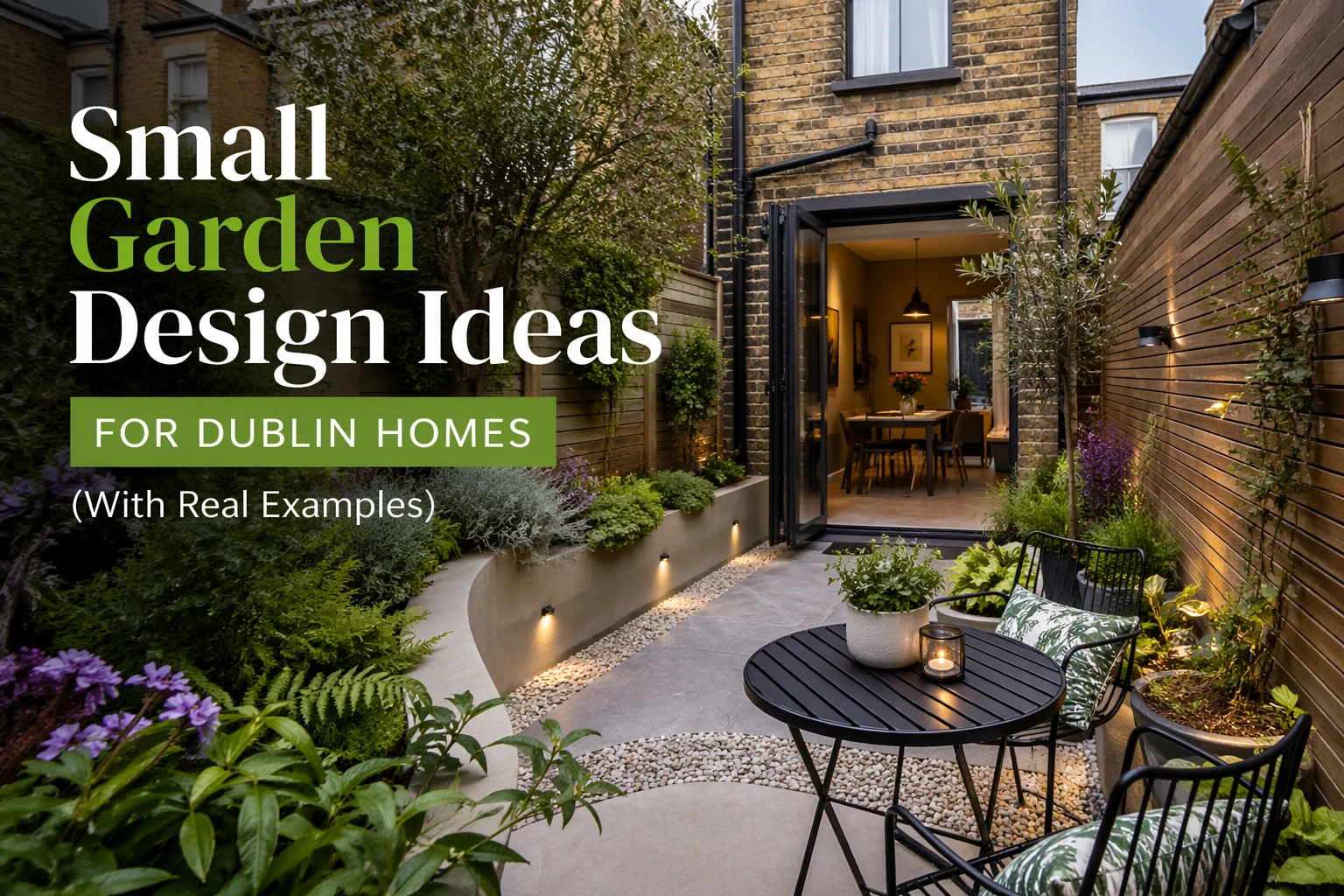
Most Dublin gardens are small. The typical rear garden in a terraced or semi-detached home is 30–60m², and many newer townhouses and apartments have even less. But a small garden doesn’t mean a boring garden. With the right small garden design, a compact Dublin space can feel bigger than it actually is, function beautifully for family life, and look stunning all year round.
If you’re looking for practical garden ideas for Dublin homes that genuinely work — not magazine fantasies from Mediterranean climates — this guide is based on real projects delivered by Lion Paving & Landscaping across Dublin’s suburbs. We’ve been designing and building small gardens in areas from Dundrum and Rathfarnham to Swords and Santry for over 8 years, and we know what works in compact Irish spaces.
Why Small Garden Design in Dublin Needs a Different Approach
Designing a small garden isn’t about scaling down a big garden — it’s a completely different discipline. In a large garden, you can afford empty space, sweeping lawns, and gradual transitions. In a compact Dublin garden, every single square metre has to earn its place. The wrong material choice, an oversized lawn, or poor proportions can make a small space feel even smaller and more cluttered.
The good news is that small garden design often produces more satisfying results than large-scale projects. With a clear plan and quality materials, a 30m² garden can feel like a genuine outdoor room — a space that’s defined, intentional, and enjoyable to spend time in. Here are the ideas that consistently deliver the best results in Dublin’s compact gardens.
10 Small Garden Ideas for Dublin Homes That Actually Work
1. Zone Your Space Into Distinct Areas
The single most effective technique in small garden design is zoning. Rather than treating the garden as one flat area, divide it into distinct zones — even if each is only a few square metres. A patio dining area near the house, a planting zone with raised beds along the boundaries, and a small lawn or gravel area for children create the illusion of multiple rooms within one compact garden.
Use changes in surface material to define zones — paving to artificial grass to gravel — rather than physical barriers like walls that eat into precious space. Subtle level changes (even a single step up or down) make zones feel distinct without any visual clutter. This approach works particularly well in Dublin’s rectangular rear gardens, where the space might be as narrow as 4–6 metres.
2. Choose the Right Paving Material
In a small Dublin garden, the patio often occupies the largest proportion of the space, so the material you choose matters enormously. Larger format slabs (600×600mm or 900×600mm) create a sense of openness with fewer joints. Light-toned porcelain or limestone reflects light and makes a compact space feel bigger. Avoid using too many different materials — one or two complementary surfaces are plenty. For a detailed comparison of materials and Dublin pricing, see our complete buyer’s guide to paving slabs for Irish gardens or explore our natural stone vs porcelain comparison.
3. Go Vertical with Planting
When ground space is limited, your walls and fences become your planting surfaces. Climbers like jasmine, clematis, and star jasmine can transform a bare fence into a living green wall. Trellis panels mounted to walls support climbing plants without using any ground space. Wall-mounted planters and hanging baskets add colour at eye level. Tall, narrow plants like bamboo, ornamental grasses, and columnar trees (such as Fastigiata varieties) provide height and screening without spreading wide. Vertical planting is one of the most underused small garden ideas in Ireland, yet it’s one of the most effective.
4. Build Raised Beds for Structure and Planting
Raised beds are one of the most effective tools in compact garden design. They create structure and definition, add height variation that makes the space more interesting, and clearly separate planting from paving. Sleeper-built or block-built raised beds can double as informal seating when capped with a wide stone or timber top. Keep beds narrow enough to reach across (no wider than 600mm) so you can maintain plants from the path side without stepping into the bed.
Raised beds also solve Dublin’s heavy clay soil problem — fill them with quality topsoil and compost, and your plants will thrive regardless of what’s underneath. Combine raised beds with retaining walls if your garden has a slope, creating flat, usable terraces from otherwise wasted ground.
5. Consider Artificial Grass for a Low-Maintenance Lawn
In a small Dublin garden, a tiny real lawn can be more trouble than it’s worth — it’s too small to mow easily, gets patchy in shade, and turns muddy with any use. Artificial grass is a practical alternative that stays green year-round, drains quickly, and creates a soft surface for children and pets. Even 5–10m² of green makes a compact garden feel fresh and alive without any ongoing maintenance. If you’re weighing up the options, our artificial grass vs real lawn comparison covers the honest pros and cons.
6. Add Garden Lighting to Extend Usable Hours
Lighting is arguably more important in small gardens than in large ones. It extends the usability of the space into the evening, which is when most Dublin homeowners actually use their gardens. LED uplights on feature walls, recessed ground lights in paving, solar path markers, and warm-toned string lights all create atmosphere. Good lighting also makes a small garden appear larger by drawing the eye to illuminated features rather than the boundaries. Our garden features service includes professional lighting design and installation.
Looking for small garden design ideas tailored to your Dublin home? We offer free site visits to assess your space, discuss your ideas, and provide a detailed quote. Call +353 85 778 0394 or request a free consultation here.
7. Use Mirrors and Reflective Surfaces
Outdoor mirrors mounted on fences or walls create a surprising sense of depth in a small garden. Choose weatherproof mirrors designed for outdoor use, and position them to reflect planting or light rather than just the back of your house. Light-coloured rendered walls and pale paving also reflect light around the space, making it feel brighter and more open. This is a simple trick that landscape designers have used for decades in courtyard and city gardens.
8. Keep Boundaries Clean and Consistent
In a compact garden, the boundaries dominate your field of vision. Mismatched panels, crumbling walls, or patchy hedging make the whole space feel neglected. Fresh garden fencing in a consistent style and colour (dark stain works particularly well as a backdrop for planting) immediately elevates the garden’s appearance. Rendered block walls painted in a single tone create a clean, modern canvas. For hedging, keep it trimmed and compact — an overgrown hedge in a small garden eats valuable space. See our hedge trimming guide for species-specific advice.
9. Create a Focal Point
Every small garden needs one feature that draws the eye and anchors the design. This could be a specimen tree or large structural plant, a water feature (even a simple wall-mounted spout), a piece of garden sculpture, or a well-positioned fire pit or chiminea. The focal point gives the garden a sense of purpose and prevents it from feeling like a random collection of elements. In a Dublin courtyard garden, a single olive tree or Japanese maple in a quality pot can provide the structure the entire space needs.
10. Design for Low Maintenance from the Start
The best small garden ideas for Dublin are ones you can maintain easily. Your garden should look presentable with minimal effort. Choose surfaces that self-clean in the rain (porcelain paving is excellent for this). Select evergreen plants that hold their shape without constant pruning. Use a weed-suppressing membrane under gravel or bark areas. Minimise exposed soil where weeds can establish. A low-maintenance small garden that requires a quick sweep and an annual trim is one that stays looking good year after year — and that’s what most busy Dublin homeowners actually want.
Small Garden Design Costs in Dublin (2026)
How much does it cost to transform a small Dublin garden? Here are realistic price ranges for the most common elements:
| Project | Typical Cost | What’s Included |
| Patio installation (10–20m²) | €700 – €3,000 | Excavation, sub-base, porcelain or natural stone slabs, pointing |
| Fencing (3 sides, 6ft) | €1,200 – €2,500 | Concrete posts, gravel boards, closeboard or composite panels |
| Artificial grass (10–20m²) | €550 – €1,800 | Ground prep, membrane, quality artificial turf, infill |
| Raised beds (2–3 beds) | €600 – €2,000 | Block or sleeper construction, topsoil, planting |
| Garden lighting scheme | €300 – €1,500 | LED path lights, spotlights, string lighting, wiring |
| Retaining wall (if needed) | €1,000 – €3,500 | Block or stone wall with foundations and drainage |
| Complete small garden makeover | €4,000 – €12,000 | Patio, fencing, lawn, raised beds, planting, lighting |
Best value tip: Bundling multiple elements into a single project saves 10–20% compared to booking each job separately. One mobilisation, one skip, one clean-up. For a detailed breakdown of all landscaping costs in Dublin, see our 2026 landscaping price guide.
Design Tips Specific to Dublin’s Small Gardens
Work with Dublin’s Light Conditions
Many Dublin rear gardens face north or north-east, which means limited direct sunlight — especially in winter. This affects both material and plant choices. Choose lighter-coloured paving (light grey porcelain, buff sandstone, silver granite) to reflect available light. Select shade-tolerant plants for borders — ferns, hostas, heuchera, and box hedging all thrive in Dublin’s shaded gardens. And use lighting to compensate for the short days — a well-lit small garden looks welcoming even on the darkest November evenings.
Deal with Dublin’s Drainage Challenges
Many small Dublin gardens suffer from poor drainage — heavy clay soil, compaction from years of use, and water running off neighbouring hard surfaces. Any garden renovation should address drainage from the start: channel drains at the patio edge, falls built into every hard surface, and permeable areas where water can soak away. If your garden floods regularly, see our guide to fixing waterlogged gardens in Dublin for practical solutions.
Match Your Home’s Character
A small garden design should complement the property it belongs to. A sleek porcelain patio with rendered walls suits a modern Dublin townhouse. A natural stone patio with timber sleeper beds suits an older semi-detached. And a simple cobblelock area with border planting works well for a standard estate house. Take cues from your home’s materials — the brick colour, the window frames, the front door — and carry that palette into the garden for a cohesive look.
Real Small Garden Transformations in Dublin
Here’s what’s realistically achievable in Dublin’s most common small garden scenarios:
The Typical 40m² Semi-Detached Rear Garden
This is the most common project we handle. A rectangular space, typically 8m × 5m, with 6ft fencing on three sides. Our typical approach: a 15m² porcelain or sandstone patio nearest the house for dining, a 10m² artificial grass area for children, raised sleeper beds along two boundaries with structured evergreen planting, fresh closeboard fencing on concrete posts throughout, path lighting along the fence line, and an uplighter on a feature plant. Total cost typically €6,000–€10,000. Timeline: 5–7 working days.
The Compact Terraced Courtyard (15–25m²)
City-centre and inner-suburb terraced homes often have tiny rear yards surrounded by high walls. The approach here is simpler: a single quality paving surface covering most of the floor area, rendered and painted walls for a clean backdrop, wall-mounted planters and climbers for greenery, a built-in bench seat along one wall, and festoon lighting overhead. No lawn needed — the entire space functions as an outdoor room. Total cost typically €3,000–€6,000. Timeline: 3–5 working days.
The Awkwardly Shaped Garden
L-shaped, triangular, or heavily sloped small gardens are common across Dublin’s older estates. These actually benefit from professional design, because the unusual shape creates natural opportunities for distinct zones and level changes. Retaining walls and garden steps turn slopes into usable terraces. A diagonal patio layout can make a narrow garden feel wider. Curved borders soften awkward angles. What feels like a disadvantage often becomes the garden’s most interesting feature.
Want to see more examples of our work? Browse our project gallery or call +353 85 778 0394 to arrange a free site visit at your property.
How to Choose a Landscaper for Your Small Garden in Dublin
A small garden project requires just as much skill as a large one — arguably more, because there’s no room to hide mistakes. When choosing a contractor for your small garden design in Dublin, look for someone who shows you examples of completed small garden projects (not just large ones), provides a detailed written quote, carries public liability insurance, and discusses drainage and sub-base preparation — not just the surface materials. For a full checklist, read our guide on what to look for when hiring a landscaper in Dublin.
Frequently Asked Questions
Q: How much does a small garden design cost in Dublin?
A small garden makeover (under 50m²) typically costs €4,000–€12,000 depending on materials and scope. A basic patio with fencing and planting starts around €4,000, while a comprehensive redesign with porcelain paving, raised beds, artificial grass, lighting, and premium fencing can reach €8,000–12,000. See our 2026 landscaping price guide for a full breakdown of costs.
Q: What are the best small garden ideas for Ireland’s climate?
Focus on durable, weather-resistant materials (porcelain paving, composite fencing), evergreen planting that handles shade and rain, artificial grass for muddy areas, and good drainage. Avoid high-maintenance features that need constant attention. Design for low maintenance so the garden looks great year-round with minimal effort.
Q: What is the best patio material for a small Dublin garden?
Large-format porcelain in a light tone is ideal. Fewer joints create a sense of openness, the lighter colour reflects light, and porcelain’s zero-maintenance surface is perfect for compact gardens. Indian sandstone is a warmer, more natural alternative. See our paving slab buyer’s guide for a full comparison of all materials.
Q: How can I make my small garden look bigger?
Use large-format paving to reduce visual clutter. Choose light-coloured materials. Go vertical with planting instead of spreading outward. Add mirrors or reflective surfaces. Use consistent boundary treatments. Add lighting to extend the perceived space into the evening. And keep the design simple — too many different materials in a small space makes it feel cluttered.
Q: Do I need a professional for a small garden makeover?
For hard landscaping (patios, fencing, retaining walls, steps), professional installation is strongly recommended. Poor DIY paving or fencing in a small garden is impossible to hide and can reduce your property’s value. At Lion Paving & Landscaping, we include design advice as part of our service — no separate design fee for most projects.
Q: How long does a small garden makeover take in Dublin?
Most small garden projects take 3–7 working days. A straightforward patio and fencing job can be completed in 3–4 days. A full redesign with patio, artificial grass, raised beds, fencing, and lighting typically takes 5–7 days. We provide a clear timeline before work begins.
Transform Your Small Dublin Garden with Lion Paving & Landscaping
At Lion Paving & Landscaping, a significant proportion of our projects are small garden transformations across Dublin. From 15m² terraced courtyards in Sandymount to 60m² semi-detached rear gardens in Swords, we design and build compact gardens that maximise every square metre. Every project starts with a free site visit where we assess your space, discuss your ideas, and provide a detailed written quote with no obligation.
Explore our full range of services or view our recent projects to see what’s possible in Dublin’s small gardens.
Call us: +353 85 778 0394
Email: sales@lionpavingandlandscaping.ie
Online: Request a Free Quote
Visit us: Get Directions
Lion Paving & Landscaping259 Birches Rd, Wedgwood, Dublin 16, D16Y5E5Serving North Dublin, South Dublin, Kildare & Surrounding Areas