

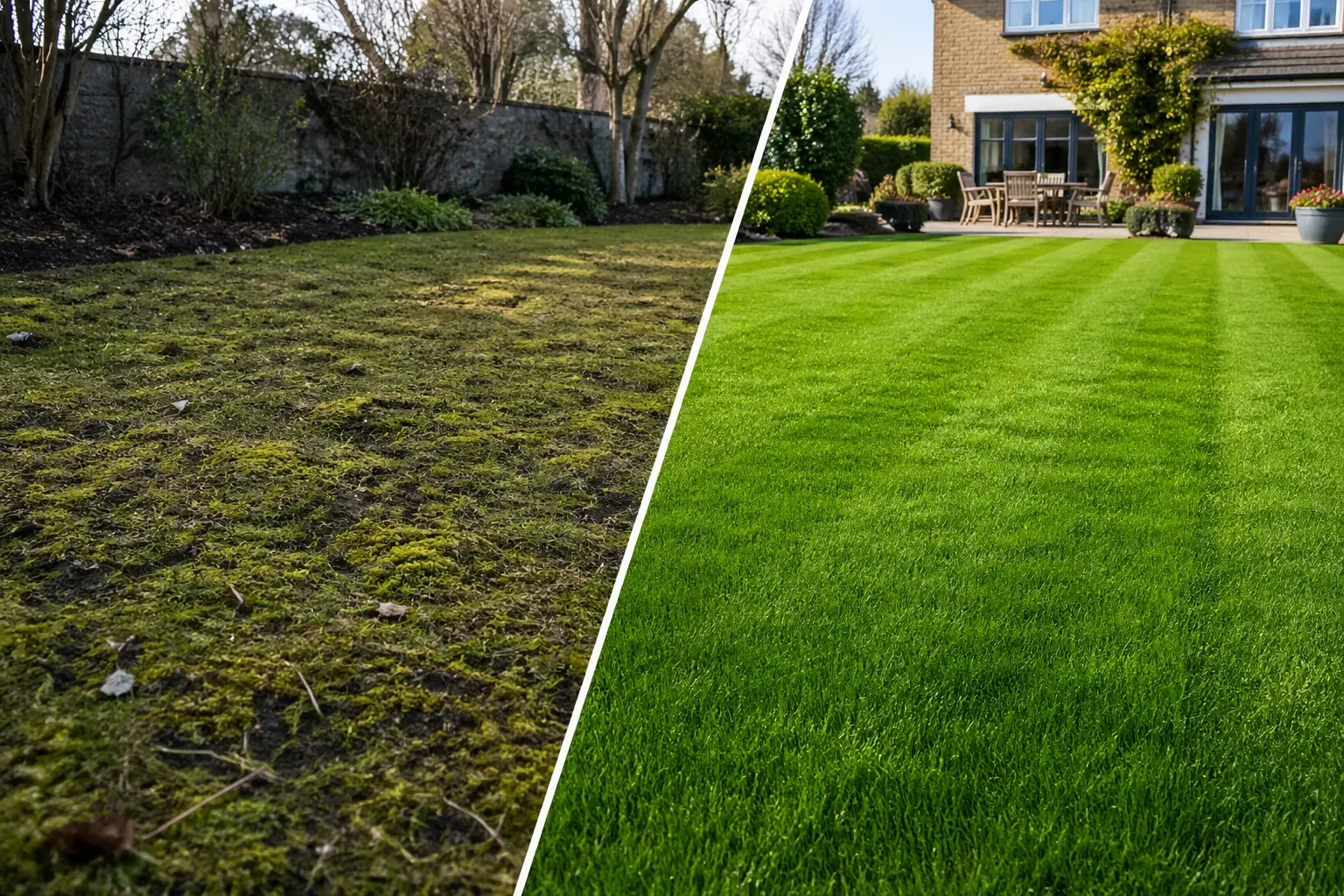
If your Dublin lawn is emerging from winter looking more like a moss carpet than a green lawn, you are not alone. Ireland’s wet, mild winters create the perfect conditions for moss to thrive while grass struggles. Compacted soil, low winter sunlight, and months of minimal growth leave most Dublin lawns looking tired, patchy, and green only where the moss is growing. Spring lawn care is essential to reverse this damage and set your lawn up for a healthy growing season.
The good news is that spring is your lawn’s recovery window. With the right treatment programme applied at the right time, even the most neglected lawn can be transformed within 6–8 weeks. Here is the step-by-step process that works in Dublin’s specific conditions.
Step 1: Assess the Damage (March)
Before doing anything, walk your lawn and honestly assess what you are dealing with. Is moss the dominant problem? Are there bare patches where grass has died? Is the lawn spongy underfoot, indicating waterlogging or compaction? Are there areas of standing water after rain? Is the grass thin and weak, or just dormant and ready to grow? The answers determine your treatment plan. A lawn that is 70% or more moss needs a more aggressive approach than one that is simply thin and tired after winter.
Step 2: First Mow of the Season (Mid to Late March)
Wait until the grass is actively growing and has reached 5–7cm before the first mow. Set your mower to its highest setting and remove no more than the top third of the grass. This first cut stimulates tillering (sideways growth), which thickens the lawn. Mow again a week later, lowering the blade by one notch. By the third mow, you can set the blade to your preferred summer height (typically 25–35mm for a neat lawn, 35–50mm for a family lawn). Never scalp a lawn in spring — it stresses the grass and allows weeds and moss to colonise the bare soil.
Step 3: Kill the Moss (Late March to Early April)
Apply a ferrous sulphate (iron sulphate) based moss killer to the entire lawn. Follow the manufacturer’s application rate carefully — applying too much will blacken the grass as well as the moss. Water it in if rain does not follow within 48 hours. Within 7–14 days, the moss will turn black and die. Do not try to rake it out before it is fully dead, or you will spread live moss spores across the lawn and make the problem worse.
Step 4: Scarify the Lawn (2–3 Weeks After Moss Treatment)
Once the moss has blackened, scarify the lawn. Scarifying means aggressively raking out the dead moss, thatch (dead organic matter), and debris that sit at the base of the grass. This opens up the soil surface and allows air, water, and nutrients to reach the grass roots. You can use a spring-tine rake for small lawns, but a powered scarifier is far more effective and saves hours of back-breaking work. Be warned: your lawn will look terrible immediately after scarifying. This is completely normal — it is about to get much better.
Want professional scarifying and lawn treatment? Our team handles complete spring lawn care programmes across Dublin. Call +353 85 778 0394 for a free assessment.
Step 5: Aerate Compacted Areas
After scarifying, aerate any compacted areas of the lawn. Use a hollow-tine aerator (which removes plugs of soil) rather than a solid-tine fork (which just pokes holes). Focus on high-traffic areas, shaded zones, and any areas where water pools after rain. Aeration improves drainage, allows oxygen to reach roots, and creates the conditions grass needs to outcompete moss. Sweep up the soil plugs and brush horticultural sand into the holes to keep them open and improve long-term drainage.
Step 6: Overseed Bare Patches (April)
After scarifying and aerating, you will have bare patches where moss has been removed. Overseed these areas with a quality lawn seed mix suited to your conditions. For most Dublin gardens, a hard-wearing family lawn mix is ideal. For shaded areas, choose a shade-tolerant mix. Rake the seed lightly into the soil surface, firm it down gently, and water if rain is not forecast. Keep the seeded areas moist for 2–3 weeks until germination occurs. Avoid heavy foot traffic on newly seeded areas for at least 4–6 weeks.
Step 7: Feed the Lawn (Mid-April)
Once new grass is established and the lawn is actively growing, apply a spring lawn feed. Choose a product high in nitrogen (N) to promote strong green growth, with some phosphorus (P) for root development and potassium (K) for disease resistance. Apply evenly using a spreader — uneven application creates dark green stripes and potentially burns the grass. Water in thoroughly if rain does not follow within 48 hours.
Preventing Moss from Coming Back
Moss always returns if the underlying conditions remain unchanged. The four main causes of moss in Dublin lawns are poor drainage (compacted or clay soil), shade (north-facing gardens or overhanging trees), low soil pH (acidic conditions favour moss over grass), and weak grass that cannot outcompete moss. Long-term solutions include annual aeration to improve drainage, pruning overhanging trees and shrubs to increase light, applying lime if soil testing shows acidic conditions, maintaining a regular feeding programme to keep grass thick and vigorous, and mowing regularly at the correct height throughout the growing season.
If your garden has persistent drainage issues contributing to moss, our guide to fixing waterlogged gardens in Dublin covers practical solutions.
When to Consider Replacing Your Lawn Entirely
If your lawn is beyond saving — more than 80% moss, severely compacted clay, or in deep permanent shade — renovation may not be worth the effort. Two alternatives deliver an instant result. Artificial grass provides a permanently green, zero-maintenance surface that thrives in shade and handles heavy use. It is ideal for Dublin families who want a usable lawn without ongoing work. Freshly laid turf gives you a real lawn instantly — established and usable within 2–3 weeks. Both options bypass the months-long recovery that renovation requires.
For a detailed comparison, see our artificial grass vs real lawn guide.
🌿
Tired of Fighting Moss Every Year?
We offer complete spring lawn renovation (scarifying, aerating, overseeding, feeding) or a fresh start with artificial grass or new turf. Whatever your lawn needs, we can help.
Call us today: +353 85 778 0394
Or request a free quote on our contact page.
Frequently Asked Questions
Q: When should I start spring lawn care in Dublin?
Begin with the first mowing in mid-to-late March when grass reaches 5–7cm. Apply moss killer in late March or early April. Scarify and aerate 2–3 weeks later. Overseed and feed in mid-to-late April. The full programme takes about 6–8 weeks from start to finish.
Q: How do I get rid of moss in my Dublin lawn permanently?
You cannot permanently eliminate moss — it is a natural organism that thrives in Dublin’s climate. But you can control it by improving drainage (aeration), increasing sunlight (pruning), keeping grass thick and healthy (regular feeding), and treating with ferrous sulphate annually. Address the underlying causes, and moss becomes manageable.
Q: Is it too late to scarify in May?
May is the upper limit. Ideally, scarify in late March or April when the grass has the full growing season ahead to recover. Scarifying in May or later means the lawn has less time to fill in before summer stress. Autumn (September–October) is an alternative window.
Q: How much does professional lawn care cost in Dublin?
A professional scarification and aerating costs €100–€250 for an average Dublin lawn. A full spring renovation (scarifying, aerating, overseeding, feeding) costs €200–€400. New turf costs €12–€20/m² installed. Artificial grass costs €55–€90/m².
Q: Should I replace my lawn with artificial grass?
If you spend significant time and money battling moss, waterlogging, and bare patches every year, artificial grass is worth considering. It stays green year-round with zero maintenance and is particularly effective in shaded Dublin gardens where real grass struggles.
Get Your Dublin Lawn Looking Its Best
Whether you need lawn renovation, new turf, or artificial grass, we handle it all. Explore our lawn and garden services or contact us for a free consultation.
Call us: +353 85 778 0394
Email: sales@lionpavingandlandscaping.ie
Online: Request a Free Quote
Visit us: Get Directions
Lion Paving & Landscaping259 Birches Rd, Wedgwood, Dublin 16, D16Y5E5Serving North Dublin, South Dublin, Kildare & Surrounding Areas