

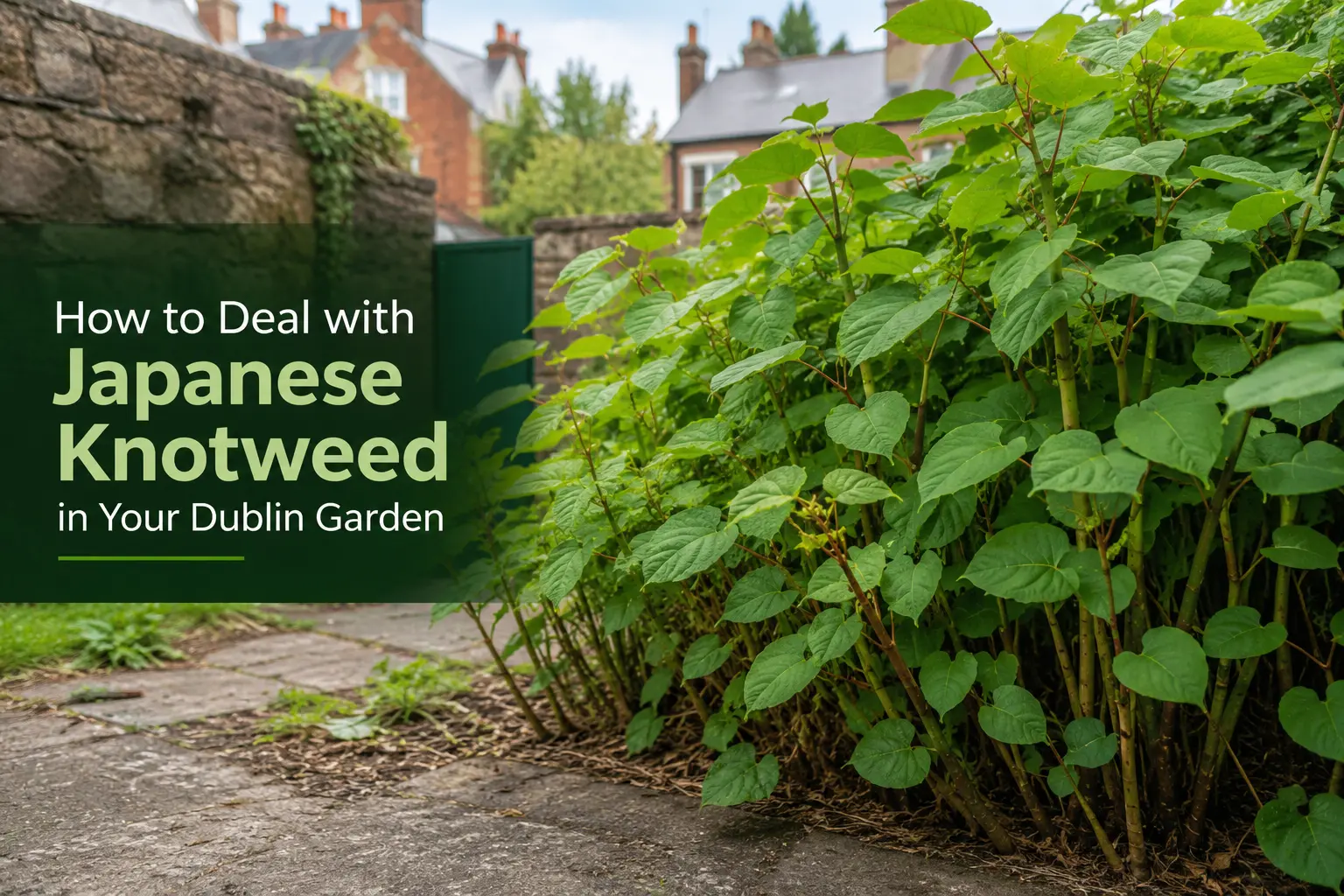
You are clearing overgrowth at the back of the garden and notice something unfamiliar — thick, bamboo-like stems with a zigzag pattern, broad heart-shaped leaves, and clusters of small white flowers. A quick search confirms your worst suspicion: Japanese knotweed. Suddenly, the garden renovation you were planning feels a lot more complicated.
Japanese knotweed is one of the most destructive invasive plants in Ireland. It can damage foundations, walls, drainage systems, and paving. It affects property valuations and mortgage applications. And under Irish law, you have certain obligations if it is growing on your land. But it is not a death sentence for your garden project. With the right approach, Japanese knotweed can be managed and your garden can still be transformed.
How to Identify Japanese Knotweed in Dublin
Correct identification is the essential first step. Japanese knotweed (Fallopia japonica) looks different depending on the season. In spring (March–April), red or purple shoots emerge from the ground, resembling asparagus. By summer (May–August), it grows rapidly to 2–3 metres tall with dense, broad, shield-shaped leaves arranged in a zigzag pattern on bamboo-like stems. In late summer (August–September), clusters of small creamy-white flowers appear. In winter, the stems die back to brown, hollow canes that persist above ground.
Key identifier: The zigzag stem pattern and shield-shaped leaves with a flat base are the most reliable identifying features. Do not confuse it with bindweed, Russian vine, or giant hogweed — all are different plants requiring different treatment.
Why Japanese Knotweed Is a Problem for Dublin Gardens
Japanese knotweed is problematic for three reasons. First, it damages structures. Its roots (rhizomes) can extend 3 metres deep and 7 metres horizontally from the visible plant. They exploit cracks in foundations, walls, drainage pipes, and paving, causing significant structural damage over time. Second, it affects property value. Most Irish mortgage lenders require a Japanese knotweed management plan before approving a mortgage on affected properties. It can reduce property value by 5–15% if untreated. Third, it is almost impossible to remove without professional help. Cutting, mowing, or digging it up without proper treatment causes it to spread. Even a fragment of rhizome weighing less than one gram can regrow into a new plant.
Your Legal Obligations in Ireland
Under the European Communities (Birds and Natural Habitats) Regulations 2011, it is illegal to plant, disperse, or allow the spread of Japanese knotweed in Ireland. If knotweed spreads from your property to a neighbouring property, you could be held liable. While there is no legal requirement to remove it from your own land, you must not allow it to spread beyond your property boundary. If you are selling a property, you are required to disclose its presence to potential buyers.
What to Do If You Find Knotweed: Step-by-Step
Step 1: Confirm Identification
Take clear photographs and consult a specialist. Several Irish companies offer identification services, some via photograph submission. Do not attempt to remove or treat the plant until identification is confirmed.
Step 2: Do Not Disturb It
Do not cut, dig, strim, mow, or burn Japanese knotweed. Any disturbance risks spreading fragments, which will grow into new plants. Do not move soil from an affected area. Do not add cuttings to garden waste or compost.
Step 3: Contact a Specialist Treatment Company
Professional treatment typically involves herbicide injection directly into the stems (glyphosate-based), applied over 2–4 growing seasons. This is the most effective and least disruptive method. Some companies also offer excavation and removal of contaminated soil, though this is significantly more expensive and may require disposal at a licensed facility.
Step 4: Get a Management Plan
A professional knotweed management plan documents the infestation, the treatment programme, expected timelines, and monitoring. This is essential if you are selling the property or applying for a mortgage. It demonstrates to lenders and buyers that the issue is being professionally managed.
Japanese Knotweed Treatment Costs in Dublin
| Treatment Method | Typical Cost | Timeline | Best For |
| Herbicide injection (small area) | €500–€1,500 | 2–4 growing seasons | Most residential gardens |
| Herbicide injection (larger area) | €1,500–€5,000 | 2–4 growing seasons | Multiple stands, boundary issues |
| Excavation and removal | €5,000–€20,000+ | Weeks | Urgent construction timelines |
| Management plan (documentation) | €200–€500 | One-off | Property sales, mortgage applications |
Can You Still Landscape a Garden with Knotweed?
Yes — with careful planning. At Lion Paving & Landscaping, we work with knotweed treatment specialists to coordinate landscaping projects alongside treatment programmes. In many cases, patio installation, fencing, and planting can proceed in unaffected areas of the garden while treatment is ongoing in the affected zone. The key is professional assessment first — we need to know the extent of the rhizome spread before planning any groundworks that could disturb contaminated soil.
If you are planning a garden renovation and suspect knotweed, contact us and we can advise on the best approach for your specific situation.
Frequently Asked Questions
Q: Is Japanese knotweed common in Dublin?
Yes. Japanese knotweed is found across Dublin, particularly along rivers, railways, and on former development sites. It is common in both inner-city and suburban areas. If your garden borders a river, railway, or derelict site, inspect for knotweed before starting any landscaping work.
Q: Will Japanese knotweed damage my patio or driveway?
It can. Knotweed rhizomes exploit existing cracks and weaknesses in paving, concrete, and tarmac. It does not typically break through intact, properly laid surfaces, but it will grow through joints, edges, and any area where the surface is compromised.
Q: Can I remove Japanese knotweed myself?
It is not recommended. DIY removal typically makes the problem worse by spreading fragments. Professional herbicide treatment is the most effective approach for residential gardens. It takes 2–4 growing seasons but achieves lasting control.
Q: Does Japanese knotweed affect property value in Dublin?
Untreated knotweed can reduce property value by 5–15% and complicate mortgage applications. A professional management plan with documented treatment reassures buyers and lenders that the issue is being addressed.
Q: Can I sell a property with Japanese knotweed in Dublin?
Yes, but you must disclose its presence. A professional management plan showing ongoing treatment makes the property mortgageable for most lenders. Many Dublin properties have been successfully sold with knotweed management plans in place.
Call us: +353 85 778 0394
Email: sales@lionpavingandlandscaping.ie
Online: Request a Free Quote
Visit us: Get Directions