

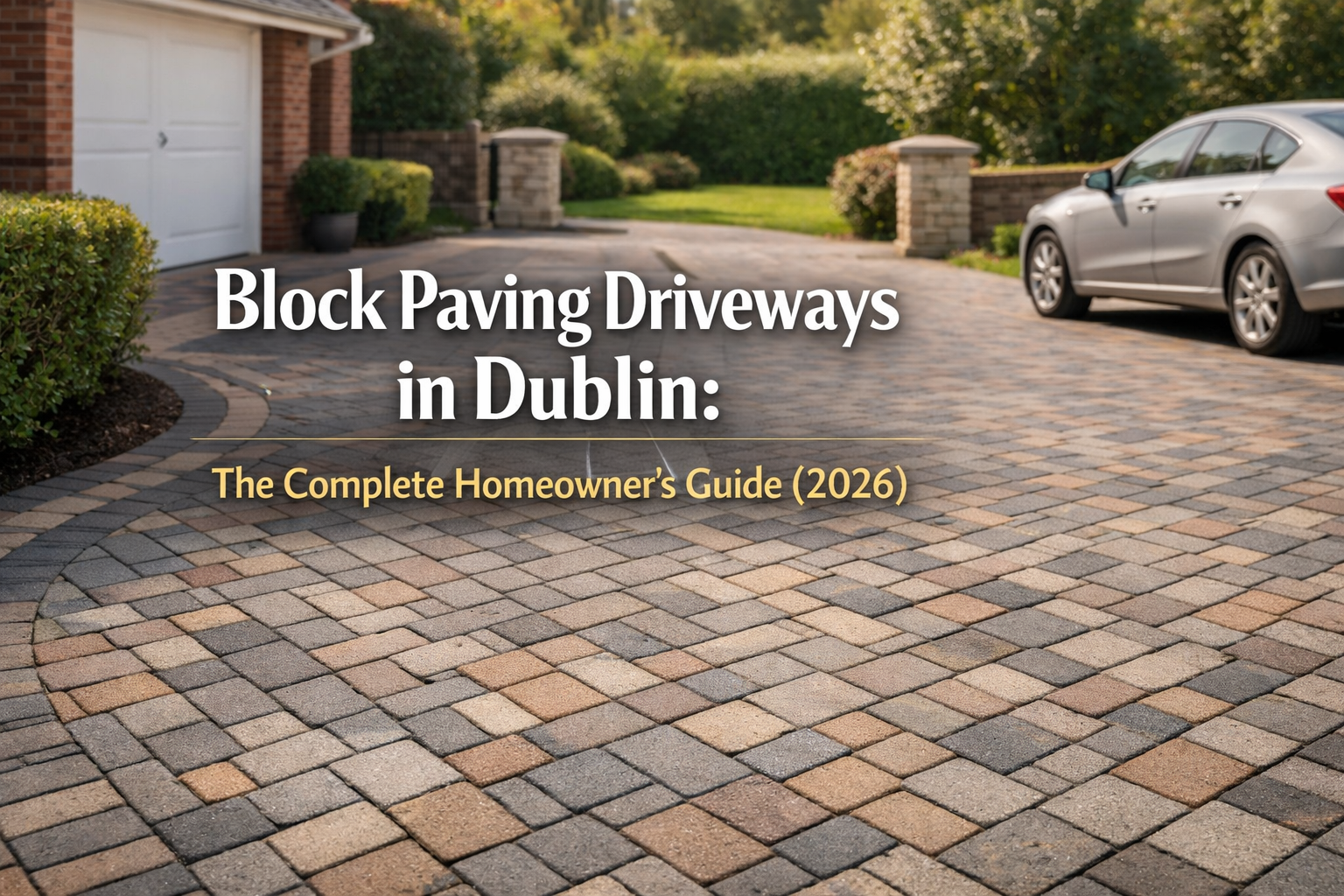
Your driveway is the first thing visitors see when they arrive at your home — and in Dublin’s increasingly design-conscious property market, a well-laid block paving driveway does far more than just provide somewhere to park. It defines your home’s kerb appeal, increases property value, and creates a durable, low-maintenance surface that handles decades of Irish weather.
But not all block paving is created equal. The material you choose, the pattern it’s laid in, the quality of the sub-base underneath, and the contractor who installs it all determine whether your driveway still looks sharp in 20 years or starts sinking and weeding within 3. This guide covers everything Dublin homeowners need to know — from Lion Paving & Landscaping’s 8+ years of experience installing driveways across Dublin and Kildare.
What Is Block Paving and Why Is It So Popular in Dublin?
Block paving — commonly called cobblelock in Ireland — consists of individual bricks or blocks laid in interlocking patterns on a compacted sand and aggregate base. Unlike poured surfaces like tarmac or concrete, block paving is modular: each block is a separate unit, which means individual blocks can be lifted and replaced if damaged, and the surface can flex slightly with ground movement without cracking.
It’s the most popular driveway surface in Dublin for several reasons: it offers enormous design flexibility with hundreds of colour, shape, and pattern combinations; it’s extremely durable when installed correctly (25–30+ year lifespan); individual blocks can be replaced without disturbing the rest of the driveway; it drains well, especially with permeable options; and it adds genuine kerb appeal and property value.
Types of Block Paving Available in Dublin
Standard Concrete Cobblelock
The workhorse of Dublin driveways. Made from pressed concrete, available in a wide range of colours (charcoal, grey, buff, rustic, brindle) and sizes. Kilsaran and Tobermore are the most common Irish manufacturers, both offering 25-year product guarantees. Standard cobblelock is the most cost-effective block paving option and suits the vast majority of Dublin driveways.
Cost: €60 – €90/m² installed
Granite-Effect Cobblelock
A premium version of standard cobblelock with a surface finish that mimics the look of natural granite. It has a more refined, speckled appearance compared to standard blocks. Ideal for homeowners who want a higher-end look without the full cost of natural stone.
Cost: €70 – €100/m² installed (typically €10–15/m² more than standard)
Tumbled / Aged-Effect Blocks
These blocks are mechanically tumbled after manufacture to create a worn, weathered look that resembles reclaimed cobblestones. They’re excellent for period properties, cottage-style homes, or any driveway where you want instant character. The irregular edges also make minor imperfections in laying less visible.
Cost: €75 – €110/m² installed
Permeable Block Paving
Permeable paving is designed to allow rainwater to drain through the surface into the ground below, rather than running off into storm drains. This is increasingly important in Dublin as local authorities enforce Sustainable Urban Drainage Systems (SUDS) requirements for new builds and significant driveway alterations. Permeable blocks have wider joints or built-in drainage channels that let water pass through.
Cost: €80 – €120/m² installed
Important note: If you’re replacing a gravel or lawn driveway with any impermeable surface (standard cobblelock, tarmac, concrete), you may require planning permission under Dublin’s SUDS regulations. Permeable block paving often avoids this requirement. We’ll cover planning rules in detail later in this guide.
Natural Stone Setts
For a truly premium finish, natural granite or limestone setts (small-format stone blocks) offer unmatched elegance and durability. Often used as borders or feature areas within a cobblelock driveway rather than the entire surface. Granite setts are virtually indestructible and can last 50+ years.
Cost: €100 – €150/m² installed (or €15–25/linear metre as a border)
Thinking About a New Block Paving Driveway?
We supply and install all types of block paving across Dublin and Kildare — from standard cobblelock to premium granite-effect and permeable options. Every job includes full excavation, proper sub-base, and a finish built to last.
Call us today: +353 85 778 0394
Or request a free quote on our contact page.
Block Paving Patterns: Which Layout Works Best?
The laying pattern you choose affects both the appearance and the structural performance of your driveway. Here are the most common patterns used in Dublin:
Herringbone (45° or 90°)
The gold standard for driveways. Blocks are laid in a zigzag pattern at either 45 or 90 degrees to the edge. Herringbone is the strongest pattern because the interlocking arrangement distributes load across multiple blocks simultaneously — it’s the only pattern recommended for driveways that will carry regular vehicle traffic. The 45-degree version is the most popular in Dublin as it creates a dynamic visual effect.
Stretcher Bond (Running Bond)
Blocks are laid in parallel rows, each row offset by half a block — like a brick wall laid flat. Clean, simple, and modern-looking. While structurally adequate for light residential use, stretcher bond is less resistant to tracking (blocks shifting under repeated tyre loads) than herringbone. Best suited to pathways, patios, or driveways with light use.
Basketweave
Pairs of blocks are laid in alternating horizontal and vertical groups, creating a woven effect. It’s an attractive traditional pattern that works well for cottage-style properties and smaller driveways. Not as structurally strong as herringbone for heavy traffic areas.
Mixed Patterns with Borders
Many of the best-looking block paving driveways in Dublin combine patterns — for example, a herringbone main field with a contrasting soldier-course border in a different colour or material. Adding a granite sett border to a standard cobblelock driveway is a cost-effective way to elevate the overall look significantly.
Block Paving Driveway Costs in Dublin (2026)
Driveway costs in Dublin depend on the size, material, existing ground conditions, access, and complexity of the design. Here’s what you can realistically expect to pay for a professionally installed block paving driveway in 2026:
| Component | Typical 50m² Driveway | Notes |
| Standard cobblelock | €3,000 – €4,500 | €60–€90/m² | Most popular choice |
| Granite-effect cobblelock | €3,500 – €5,000 | €70–€100/m² | Premium finish |
| Permeable block paving | €4,000 – €6,000 | €80–€120/m² | SUDS compliant |
| Granite sett border (add-on) | +€400 – €800 | Per driveway perimeter | High visual impact |
| Old driveway removal | +€500 – €1,200 | Depends on existing surface and skip hire |
| Drainage/channel installation | +€300 – €800 | If not already adequate |
| New entrance pillars/walls | +€1,500 – €4,000 | If upgrading the entrance simultaneously |
What’s included in the price: A reputable contractor’s quote should cover full excavation of the existing surface, disposal of spoil, a properly compacted MOT Type 1 sub-base (minimum 150mm for driveways), a sharp sand laying course, the blocks themselves, edging kerbs or restraints, kiln-dried sand jointing, and full site clean-up. If any of these elements are missing from a quote, ask why — cutting corners on the sub-base or edging is the most common cause of driveway failure.
What Does Professional Block Paving Installation Involve?
Understanding the installation process helps you assess whether your contractor is doing the job properly. Here’s what a quality block paving installation from Lion Paving & Landscaping looks like, step by step:
Step 1: Site Survey and Design
We visit your property, measure the driveway area, assess the existing surface and ground conditions, check drainage, and discuss your design preferences. We’ll advise on the best block type, colour, and pattern for your property and provide a detailed written quote.
Step 2: Excavation
The existing surface is fully removed, and the area is excavated to the correct depth. For a standard block paving driveway, this means excavating approximately 250–300mm below the finished level to accommodate the sub-base, laying course, and blocks. All spoil is removed from the site.
Step 3: Sub-Base Construction
This is the most critical phase. A minimum 150mm layer of MOT Type 1 crushed stone is laid and compacted in layers using a plate compactor. The sub-base must be level, properly graded for drainage, and compacted to a density that will support vehicle loads for decades. A poor sub-base is invisible once the blocks are laid — but it’s the number one cause of sinking, rutting, and block displacement.
Step 4: Edge Restraints
Concrete edging kerbs or restraints are installed around the full perimeter of the driveway and bedded in concrete. These prevent the blocks from spreading outward under vehicle load. Without proper edge restraints, the blocks at the edges will gradually creep apart, opening joints and allowing the entire surface to shift.
Step 5: Laying Course and Block Laying
A 30–50mm layer of sharp sand is screeded to a precise, level surface. Blocks are then laid by hand in the chosen pattern, cut to fit at edges and around obstacles using a diamond-blade block splitter. The pattern starts from a fixed reference point (usually the front door or garage) to ensure symmetry.
Step 6: Compaction and Jointing
Once all blocks are laid, the entire surface is compacted with a plate compactor to settle the blocks into the sand bed. Kiln-dried jointing sand is then swept into the joints, and the surface is compacted again. This locks the blocks together, creating the interlocking structure that gives block paving its strength.
Want to See How Your New Driveway Could Look?
We offer free site visits and can show you samples of blocks, borders, and patterns at your property. No obligation, no pressure — just honest advice from experienced driveway installers who’ve been doing this across Dublin for over 8 years.
Call us today: +353 85 778 0394
Or request a free quote on our contact page.
Maintaining Your Block Paving Driveway in Dublin
One of block paving’s biggest advantages is how little maintenance it needs compared to other surfaces. Here’s a practical maintenance schedule for Dublin conditions:
Regular Sweeping
Sweep your driveway every few weeks to remove leaves, dirt, and organic debris. This prevents material from building up in joints, where it decomposes and creates a perfect environment for weeds and moss. A stiff outdoor broom is all you need.
Weed Control
Weeds growing between block paving joints are the most common complaint from Dublin homeowners. Prevention is far easier than cure: keep joints topped up with kiln-dried sand (the sand compacts and hardens, leaving no room for seeds to germinate), sweep regularly, and treat emerging weeds promptly with a path-and-patio weedkiller. For severe infestations, a professional clean and re-sand is the most effective long-term solution.
Annual Pressure Wash
An annual pressure wash removes accumulated grime, algae, and moss. Use a fan nozzle rather than a pencil jet to avoid dislodging jointing sand. After washing, reapply kiln-dried sand to any joints that have been disturbed. For best results, apply a moss and algae inhibitor after cleaning.
Re-Sanding Joints
Over time, jointing sand gets washed out by rain or dislodged by cleaning. When joints become noticeably empty, sweep fresh kiln-dried sand across the surface and compact it using a plate compactor or by simply walking over it. Keeping joints full is the single most important maintenance task — it prevents weeds, stabilises the blocks, and maintains the interlock.
Do You Need Planning Permission for a Block Paving Driveway in Dublin?
This is an area where many Dublin homeowners get caught out. If you’re simply replacing an existing hard surface (like lifting old tarmac and laying block paving), you generally don’t need planning permission. However, if you’re converting a front garden (grass, gravel, or planting) into a hard driveway surface, planning permission may be required — particularly under Dublin’s SUDS (Sustainable Urban Drainage Systems) regulations.
The key rule: Any new hard surfacing over 25m² at the front of a property that drains onto a public road or into the public drainage system may require permission. Using permeable block paving can help you avoid this requirement, as the surface allows water to drain naturally into the ground rather than running off into the public system.
We always advise Dublin homeowners to check with their local planning authority before proceeding with any driveway that involves changing the surface type or creating a new dropped kerb. Our team can advise on which materials and approaches are most likely to comply with local requirements.
How to Choose the Right Block Paving Contractor in Dublin
The quality of installation matters far more than the quality of the blocks themselves. A premium cobblelock on a poor sub-base will fail faster than a budget block on a properly prepared foundation. Here’s what to look for:
Written, itemised quotes: Any reputable contractor will provide a detailed written quote breaking down materials, excavation, sub-base specification, block type, edging, drainage, and waste removal. Verbal quotes and handshake deals are a red flag.
Public liability insurance: Minimum €2 million cover. Ask to see the certificate. An uninsured contractor working on your property leaves you personally liable for any accidents or damage.
Verifiable local references: Ask for addresses of recently completed driveways in Dublin that you can drive past and inspect. Online reviews are useful, but nothing replaces seeing actual completed work.
No large upfront deposits: A professional contractor should not require a large cash deposit before starting. At Lion Paving & Landscaping, we never ask for payment until the work is complete and you’re satisfied with the result.
Clear timeline: A standard 50m² block paving driveway takes 3–5 working days for a professional crew. Be wary of contractors who promise completion in a single day — it’s impossible to properly excavate, compact a sub-base, and lay blocks to a high standard in that timeframe.
Block Paving vs Other Driveway Options in Dublin
| Material | Cost/m² (Installed) | Lifespan | Maintenance | Best For |
| Block paving (cobblelock) | €60 – €100 | 25–30+ years | Low — occasional weeding & re-sand | Kerb appeal, design flexibility, repairability |
| Tarmac | €50 – €80 | 15–20 years | Low — reseal every 5–7 years | Budget, clean modern look, quick install |
| Gravel | €40 – €70 | 10–15 years | Medium — regular raking, top-ups | Budget, SUDS compliance, rural properties |
| Imprinted concrete | €75 – €110 | 20–25 years | Low — reseal every 3–5 years | Decorative finish, no joints (no weeds) |
| Natural stone | €85 – €130 | 30–50+ years | Low — occasional sealing | Premium look, maximum durability, value add |
For a detailed comparison of patio materials, see our natural stone vs porcelain guide. For paving slab options, check our complete buyer’s guide to paving slabs.
Frequently Asked Questions
Q: How much does a block paving driveway cost in Dublin?
A standard cobblelock driveway costs €60–€90/m² installed. For a typical 50m² driveway, expect to pay €3,000–€4,500. Granite-effect blocks, permeable paving, and decorative borders increase the cost. See our full cost table above for a detailed breakdown.
Q: How long does a block paving driveway last?
A well-installed block paving driveway lasts 25–30+ years with basic maintenance. The blocks themselves can last even longer — Kilsaran and Tobermore both offer 25-year product guarantees. Lifespan depends primarily on the quality of the sub-base and edge restraints.
Q: What is the best block paving pattern for a driveway?
Herringbone (45°) is the strongest and most recommended pattern for driveways. The interlocking zigzag distributes vehicle loads across multiple blocks, preventing tracking and displacement. It’s also the most visually dynamic pattern. Stretcher bond and basketweave are better suited to patios and paths.
Q: Do I need planning permission for a block paving driveway in Dublin?
If you’re replacing an existing hard surface like-for-like, generally no. If you’re converting soft ground (grass, garden) to a hard surface over 25m² that drains onto a public road, you may need permission. Permeable block paving often avoids this requirement. Always check with your local council.
Q: How long does it take to install a block paving driveway?
A standard 50m² residential driveway takes 3–5 working days for an experienced crew. This includes excavation (day 1), sub-base and compaction (day 2), block laying (days 3–4), and finishing, cutting, and jointing (days 4–5). Larger or more complex driveways take proportionally longer.
Q: How do I stop weeds growing in my block paving?
Keep joints topped up with kiln-dried sand — this is the most effective prevention. Sweep regularly to remove organic debris where seeds can germinate. Treat emerging weeds promptly. An annual pressure wash followed by re-sanding keeps weeds under control long-term.
Get a Free Quote for Your Block Paving Driveway
At Lion Paving & Landscaping, we’ve been installing block paving driveways across Dublin for over 8 years. Every driveway we build starts with proper excavation, a fully compacted sub-base, concrete edge restraints, and quality blocks laid by experienced tradespeople. We use Kilsaran and Tobermore products as standard, and we never cut corners on the foundations that make a driveway last.
Ready to Transform Your Driveway?
From a straightforward cobblelock replacement to a premium granite-bordered design, we deliver quality results on every project. Free site visits, detailed written quotes, and no payment until you’re happy with the result.
Call us today: +353 85 778 0394
Or request a free quote on our contact page.
Email: sales@lionpavingandlandscaping.ie
Online: Request a Free Quote
Visit us: Get Directions
Lion Paving & Landscaping
259 Birches Rd, Wedgwood, Dublin 16, D16Y5E5
Serving North Dublin, South Dublin, Kildare & Surrounding Areas