

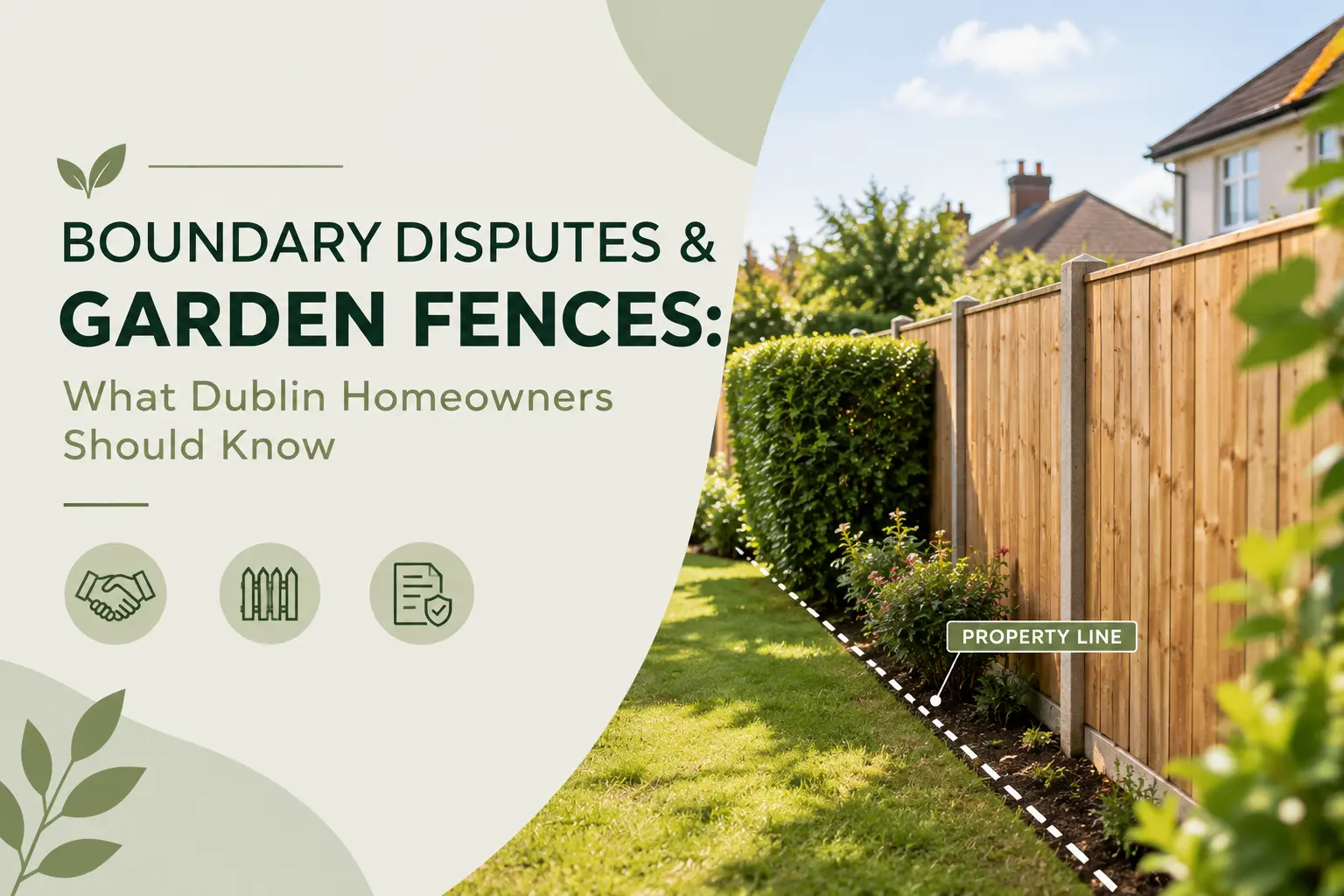
“Whose fence is it?” “Can my neighbour build a 2-metre wall without asking?” “Am I allowed to cut branches hanging over from next door?” These are questions we hear regularly from Dublin homeowners — and the answers are not always what people expect. Boundary disputes are one of the most common sources of neighbour conflict in Dublin, and most stem from misunderstandings about who owns what, who is responsible for maintenance, and what the rules actually say.
This guide covers the most common boundary and fence questions for Dublin homeowners, based on general principles of Irish property law. Important: We are landscapers, not solicitors. For specific legal disputes, always seek professional legal advice. What we can offer is practical guidance on the most common situations we encounter in 8+ years of fence installation and garden work across Dublin.
Who Owns the Boundary Fence?
This is the number one question we are asked. In Ireland, there is no universal rule that the fence on a particular side of your property is “yours.” Ownership is determined by your title deeds, which may include a boundary map showing which boundaries you are responsible for maintaining. If the deeds are silent on boundary responsibility (which is common in older Dublin properties), ownership is typically determined by the “T-mark” convention on title maps (a T on your side of the boundary means you are responsible for that fence or wall). If neither deeds nor T-marks provide clarity, the general assumption is that both neighbours share responsibility — but this is not legally binding without documentation.
Our practical advice: before replacing a boundary fence, check your title deeds. If ownership is unclear, have a friendly conversation with your neighbour and agree on shared costs or responsibilities. Most Dublin boundary situations are resolved through good communication, not legal action.
Fence Height Limits in Dublin
Under Irish planning exemptions, you can erect a fence or wall up to 1.2 metres high at the front of your property and up to 2 metres high at the side and rear without planning permission. These limits apply to the height measured from the ground on the higher side if the ground levels differ between properties. Exceeding these heights requires planning permission from your local authority. In Architectural Conservation Areas, additional restrictions may apply — check with Dublin City Council or your local county council before building.
Can My Neighbour Build a Fence Without My Permission?
If the fence is entirely within their property boundary and complies with height limits, your neighbour can build a fence or wall without your permission or consultation. They do not need your consent to replace their own fence, change its style, or increase its height (up to the exempted limits). If the fence is on the shared boundary line, both parties ideally should agree — though enforcement of shared boundary agreements can be complex without legal intervention.
Overhanging Branches and Roots
Under Irish law, you have the right to cut back branches and roots from a neighbour’s tree that overhang or encroach onto your property. You must cut only to the boundary line — not beyond. You should return the cut material to your neighbour (it remains their property). And you cannot enter their property to do the cutting without permission. If a neighbour’s tree causes damage to your property (falling branches, root damage to foundations), you may have a claim for damages — seek legal advice.
Need a New Fence or Boundary Wall?
We install closeboard, composite, and panel fencing plus rendered block and stone boundary walls across Dublin. Free site visits, detailed quotes, and quality construction that lasts.
Call us today: +353 85 778 0394
Or request a free quote on our contact page.
Common Dublin Boundary Scenarios We Encounter
Scenario: “My neighbour’s fence is falling down and they refuse to fix it”
If the fence belongs to your neighbour (confirmed by title deeds), you cannot force them to repair it. Your options are to erect your own fence on your side of the boundary (entirely within your property) or to offer to share the cost of a replacement. Many Dublin homeowners choose to install their own closeboard or composite fence just inside the boundary line, solving the problem without needing their cooperation.
Scenario: “My neighbour’s hedge is blocking my light”
Ireland does not have a specific “right to light” law for gardens (unlike some UK legislation). You can trim any growth that overhangs your property to the boundary line, but you cannot compel a neighbour to reduce the height of a hedge on their land unless it violates planning height exemptions. Diplomatic conversation is usually more effective than legal routes.
Scenario: “We disagree about where the boundary actually is”
If there is a genuine dispute about the boundary location, your title deeds and the Ordnance Survey map are the primary references. A chartered surveyor can establish the exact boundary position. In practice, most Dublin boundary disputes involve centimetres rather than metres and are best resolved through mediation rather than litigation.
Our Practical Advice for Dublin Homeowners
Check your title deeds before any boundary work. Talk to your neighbour before building or replacing a fence. If in doubt about ownership, build your fence just inside your property boundary (even 10cm makes it clearly yours). Always comply with height limits (1.2m front, 2m side/rear) unless you have planning permission. And document any agreements with neighbours about shared boundaries in writing.
For detailed fencing options, costs, and installation advice, see our garden fence installation and repair guide for Dublin homeowners.
Frequently Asked Questions
Q: Whose responsibility is the garden fence in Dublin?
Check your title deeds for boundary responsibility information. If unclear, the T-mark convention on title maps indicates responsibility. If neither applies, both neighbours are assumed to share responsibility — though this is not legally binding without documentation.
Q: What is the maximum fence height without planning permission in Dublin?
1.2 metres at the front boundary and 2 metres at the side and rear. Exceeding these heights requires planning permission. Additional restrictions may apply in Architectural Conservation Areas.
Q: Can I cut my neighbour’s overhanging branches?
Yes. You have the right to cut branches and roots that encroach onto your property, but only to the boundary line. The cut material should be returned to your neighbour. You cannot enter their property without permission.
Q: What if my neighbour refuses to fix their fence?
If the fence is theirs, you cannot compel them to repair it. Your practical option is to erect your own fence on your side of the boundary, entirely within your property. This solves the problem independently.
Q: How much does boundary fencing cost in Dublin?
Standard closeboard fencing costs €40–€85/m installed. Composite fencing costs €120–€200/m. A typical 30m boundary costs €1,200–€6,000 depending on material. See our fencing guide for a full breakdown.
Get Expert Fencing and Boundary Work in Dublin
Visit our garden fence installation and repair page or contact us for a free quote.
Call us: +353 85 778 0394
Email: sales@lionpavingandlandscaping.ie
Online: Request a Free Quote
Visit us: Get Directions
Lion Paving & Landscaping
259 Birches Rd, Wedgwood, Dublin 16, D16Y5E5
Serving North Dublin, South Dublin, Kildare & Surrounding Areas